Monday, 28 December 2015

Linear Perspective and a Mirror: Moscow Findings.


I have decided to expand the area of my research. That does not mean looking into more topics. I actually managed to become much more focused on the one I explore. On the contrary, it is much more about expanding the understanding of the chosen field of interest by finding new references for investigation.

This year we traveled to see one of the Baroque churches in the area. We found this very exciting place in Dubrovitsi. I found it intriguing as, as in many other cases, the picture I saw in my mirror was full of figures ascending upwards and looking at the visitors from above. However, this time the figures were not depicted, they were full scale sculptural pieces.

I started exploring this encounter and making links to my work. For that I created series of sketches, which I also decided to submit for the ArchiGraphicArts competition.

It is 1415 and Filippo Brunelleschi is conducting his experiment with linear perspective at San Giovanni. He is holding a plate with a painting of Florence Baptistery. He looks through a hole from the unpainted side of the panel onto a mirror. What he sees is the Baptistery set within architectural space.
 
The series of sketches explores a possibility of application of mirror as a tool to produce images of existing vertical space referring to Parma Cathedral and Dubrovitsi Church. The image of architectural space in Bruneleschis experiment is placed onto a flat surface, however Correggio's illusionistic space possesses a concave surface of a dome in Parma Cathedral. I find it particularly interesting that it is made to look like extension of real space if perceived from the right point of view or observed in a mirror. Still, when these are perceived from a different angle, depiction of he figures on a concave surface causes more distortion than if they were drawn onto a flat surface. The vertical space in Dubrovitsi Church has similar geometrical configuration  While the space perceived through a mirror it might look similar in configuration to Parma Cathedral, however it  is created by volume filled with sculptural figures. 

View inside Dubrovitsi Church
Dome painting by Correggio, Parma Cathedral


Saturday, 24 October 2015

Expanding reading list: articles and reviews

I found JSTOR incredibly helpful for identifying literature to expand my list of works to read. I am going to share some of the recent ones, which includes both articles and reviews. Here is a list with links, grouped by author:

  • Margaret Iversen 

Orthodox and Anamorphic PerspectivesReviewed Work: The Origin of Perspective by Hubert Damisch, John Goodman; Perspective as a Symbolic Form by Erwin Panofsky, Christopher S. Wood
Oxford Art Journal
Vol. 18, No. 2 (1995), pp. 81-84


Margaret Iversen 
Oxford Art Journal 
Vol. 28, No. 2 (2005) , pp. 193-202


  • Keith Broadfoot 
Perspective Yet Again: Damisch with Lacan
Oxford Art Journal
Vol. 25, No. 1 (2002), pp. 73-94


  • James Elkins
Renaissance Perspectives
Journal of the History of Ideas
Vol. 53, No. 2 (Apr. - Jun., 1992), pp. 209-230

Reviewed Work: The Science of Art, Optical Themes in Western Art from Brunelleschi to Seurat by Martin Kemp
Zeitschrift für Kunstgeschichte
54. Bd., H. 4 (1991), pp. 597-601


  • Christopher S. Wood
Reviewed Works: The Origin of Perspective by Hubert Damisch;Le Jugement de Pâris by Hubert Damisch
The Art Bulletin
Vol. 77, No. 4 (Dec., 1995), pp. 677-682

E.H. Gombrich's 'Art and Illusion: A Study in the Psychology of Pictorial Representation', 1960 The Burlington Magazine
Vol. 151, No. 1281 (December 2009), pp. 836-839
Published by: The Burlington Magazine Publications Ltd.


  • Joel Snyder
Reviewed Work: Perspective as Symbolic Form by Erwin Panofsky
The Art Bulletin
Vol. 77, No. 2 (Jun., 1995), pp. 337-340


  • Allister Neher
How Perspective Could Be a Symbolic Form
The Journal of Aesthetics and Art Criticism
Vol. 63, No. 4 (Autumn, 2005), pp. 359-373


  • David Grubbs
Review
Reviewed Work: Art and Objecthood: Essays and Reviews by Michael Fried
Chicago Review
Vol. 44, No. 3/4 (1998), pp. 193-195


  • Patrick Maynard
Review
Reviewed Works: The Science of Art: Optical Themes in Western Art from Brunelleschi to Seurat by Martin Kemp; Perspective as Symbolic Form by Erwin Panofsky, Christopher S. Wood
The Journal of Aesthetics and Art Criticism
Vol. 52, No. 2 (Spring, 1994), pp. 243-245
Published by: Wiley on behalf of The American Society for Aesthetics


  • Rudolf Arnheim
Review
Reviewed Work: Hubert Damisch: The Origin of Perspective by John Goodman
Review by: Rudolf Arnheim
Leonardo
Vol. 28, No. 1 (1995), p. 75
Published by: The MIT Press


  • Roy R. Behrens
Review
Reviewed Work: The Domain of Images by James Elkins
Leonardo
Vol. 34, No. 1 (2001), p. 77
Published by: The MIT Press


  • Alberto Pérez-Gómez 

Questions of representation: the poetic origin of architecture. 
Architectural Research Quarterly
Vol. 9, No. 3-4 (Sep., 2005) pp. 217-225
Published by: Cambridge University Press

Sunday, 14 June 2015

Contraption

I have recently been doing some sketching over those sketches completed a while ago, but never considered for development. I started looking at my proposal for the series of wearable objects and the proposal of the adjustable device, and now I realise there is an opportunity to merge them. Still, through these sketches I understood that the Imaginative Wear series should employ real space imagery, while the sketches here are probably a further development of that idea of dynamic contraption from 2011, pushed and reworked in terms of construction. It will still work with body postures and would make up that series never produces after the final outcome in 2011 as one piece and could be transformed and adjusted.

Sketch of the apparatus # 2

Sketch above was completed this year, but then sketches over it and below are the most recent ones. The latter indicate how technical problems could be resolved, and, instead of creating a heavy construction of acrylic joints, this could be a light yet adjustable device. Moreover, I have been testing 3D printing recently, so I am planning to work more with dome-like shapes rather than vault-like ones.

Sketch of the apparatus # 2

Friday, 22 May 2015

UALARM Exhibition Proposal

Recently I have been coordinating a group of UAL Alumni in Russia. For the last three moths we have been working on festival here in Moscow, which is due to happen next weekend. Luckily I found a bit of time to participate in the Exhibition within it. Though I haven't managed to develop any of my sketches further (which I will be posting later), I came up with a device to screen my video from the exhibition back in 2011.

Come and see!
Different ideas
Different ideas
Development of main idea

Sunday, 3 May 2015

Beholder and his Eye

Isn't this amazing?

http://www.wallpaper.com/art/meeting-the-man-who-draws-with-his-eyes/8806#116762

Work by Graham Fink:
http://www.grahamfink.com

Friday, 1 May 2015

Sculpture Development

I uploaded most of stuff last year working with projection and learning more about it practically and exploring theories behind it.  

I have recently been invited to participate in UAL Russia Alumni 'Share It!' debate centered around topic of '01. Reconstruction', where I have presented my work to audience of UAL Alumni and students of British Higher School of Art and Design as well as those from Moscow creative community. 

Presenting 
Me talking about my research interest

Showing sculptural work
When considering talk for this session, I analyzed my experience and got to thinking that in my practice I have been interested in sculpture, and it was really exciting for me to observe how architectural model making becomes more of a sculpture with a change of aim and thus method applied. I started thinking about the sculpture outcomes as more of a separate line of work rather than a step towards the installation, and prepared specific set of work done for this presentation, in which I managed to explore my approach to sculpture further. 

This sculpture from 2010 was created extruding the outline of the dome section.

Wax sculpture made extruding the section outline
Sculpture pushed further through hands on experimentation with form
These particular three have a much more complex shape than those that were simply extruded. Here I managed to simply experiment in the workshop, which I think allowed me establish expression I wanted to achieve, but the method I used was a bit vague.

Recently I started analysing my experience. I questioned my method for those sculptures I created in the beginning and started reimagining ways to create them using a different approach/ ways of combining my methods rather than imagining them as different directions in order to push this line of my work further. I realised I would like to look into a more systematic approach to shaping the form of the objects.

Negative space traced and filled
Lathe
This time I came up with tracing negative space, rather than outline of the section. Then, I decided to lathe it rather than extrude. 
Explanation of section
Again, as my interest was mainly about images, that could be obtained from models, I decided to make sections of 3D objects. 
Slices of negative space
It was exciting to listen to opinions when presentation finished. I was asked an interesting question whether the process could actually become a result in itself rather than a way to some sort of outcome. I am considering that and see ways the body of work completed as experimental stage could become actual work to present or exhibit. Having this method now I intend to experiment more with negative space as a substance for sculpture. I plan to explore this line of work further creating more experiments and then establishing connections to theory.

Monday, 13 October 2014

Sketches for a series of wearable objects

After a period of time rethinking my work, I have finally came up with a some sketches for a series of objects.

In this work I wish to question the role of framing for perception of real projective spaces. In this series of wearable devices I intend to explore phenomenon of fragmented visual experiences of space. These objects aim to exclude perspective from the perceptual framework and by that form an mage of non-mathematical nature.

Projection diagrams
Body positions


Pendant #1  

Pendant #2 

Ring #1

Ring #2

Costume #1

Costume #1

Costume #1

Costume #2

Monday, 15 September 2014

Journals and Books Overview

Considering the amount of time passed after my graduation, I am looking for a way to publish my written work and/or artwork images. I have been researching on peer-reviewed magazines and other on-line sources publishing research articles and art projects within art/architecture field. I have found some, which could be interesting for reading in first place, however they do accept papers for review, so publishing something looks possible.

Here is what I found so far:

http://www.jar-online.net
http://artjournal.collegeart.org
http://openartsjournal.org
http://www.imagesjournal.com
http://people.brunel.ac.uk/bst/vol0701/home.html
http://www.artmargins.com
http://www.waspjournals.com/journals/artontheline/index/index.html
http://onlineresearchjournals.org/IJAH/index.htm 
http://www.journals.elsevier.com/emotion-space-and-society/

I have researched through engines, and have also found a directory of open access journals http://doaj.org.

I am currently looking at books I would be interested in reading, so I have created a wish list in Amazon, which proved itself incredibly convenient. I will be updating it in future. http://www.amazon.co.uk/registry/wishlist/1XFSIVQ5VDDHD


Saturday, 24 May 2014

Testing Projection

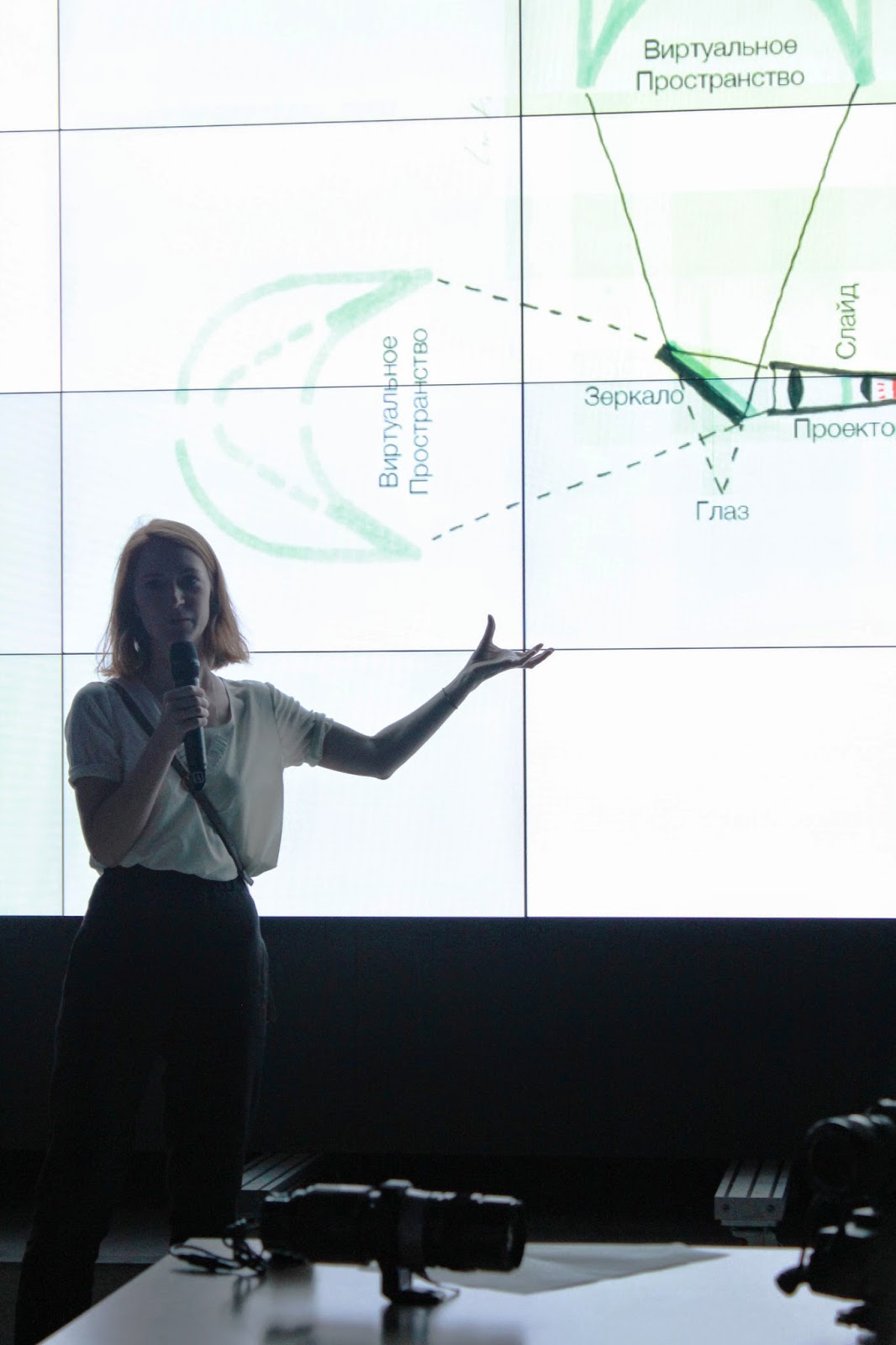
I realised that recently I have been interested in perception of spaces, depicted on a plane: printed, reflected in a mirror or screened. I have made some experiments with projection to gain a similar effect, using one of the projectors provided. I have used the following schemes to explain creation and application of the device during Thursday presentation. 

Scheme 1

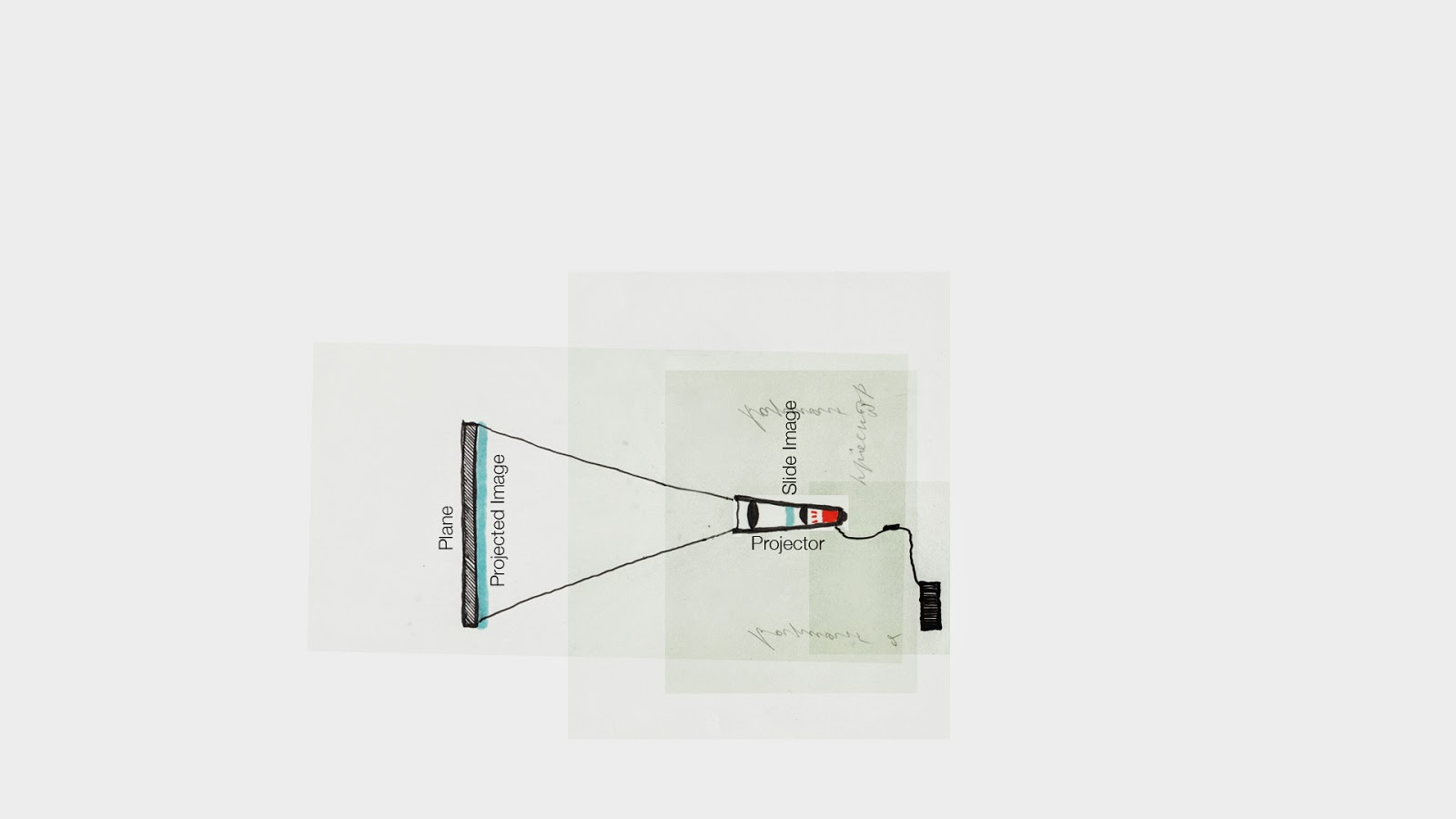
A scheme above explains how projection happens in my work. There is a custom made projector, provided by Clement Briend for a period of time with a slide is inserted into it. Lights passes through lens, slide and optics resulting in an image on a plane. There are particular specifics towards slide elaboration: to create the slide I used for projection, we screened a digital image of space and photographed it again with a help of film camera (positive film used). 

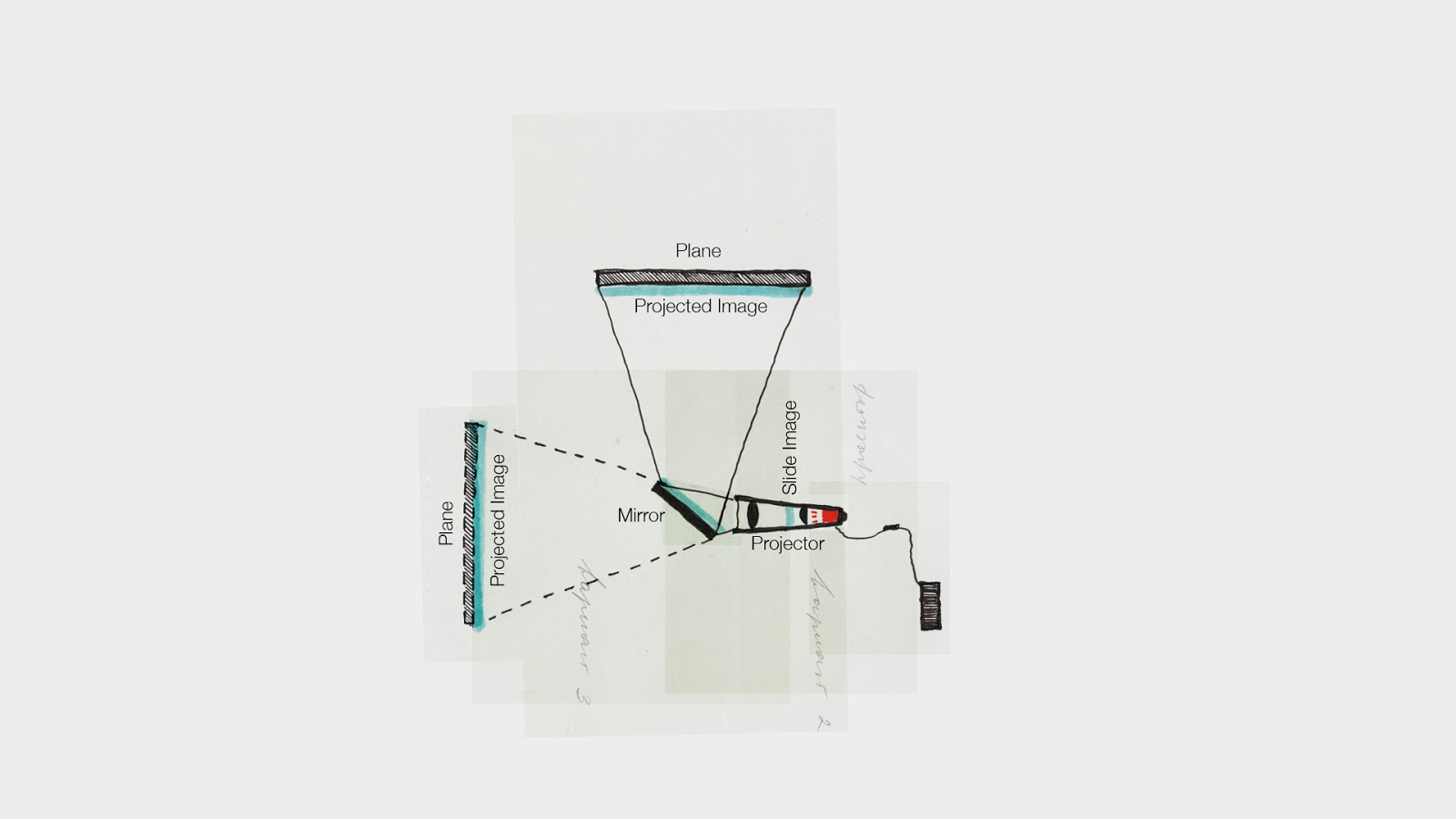
Scheme 2

I got interest in the process, during which space seen by an eye turns into digital image, then analogue images, then slide and, finally, projection. I have decided to keep viewing points used to photograph the image of space on different stages. For this I have created a device with a mirror, which allowed to change the projection direction from one used to create a film photo back to one used to make a digital photo of space. 

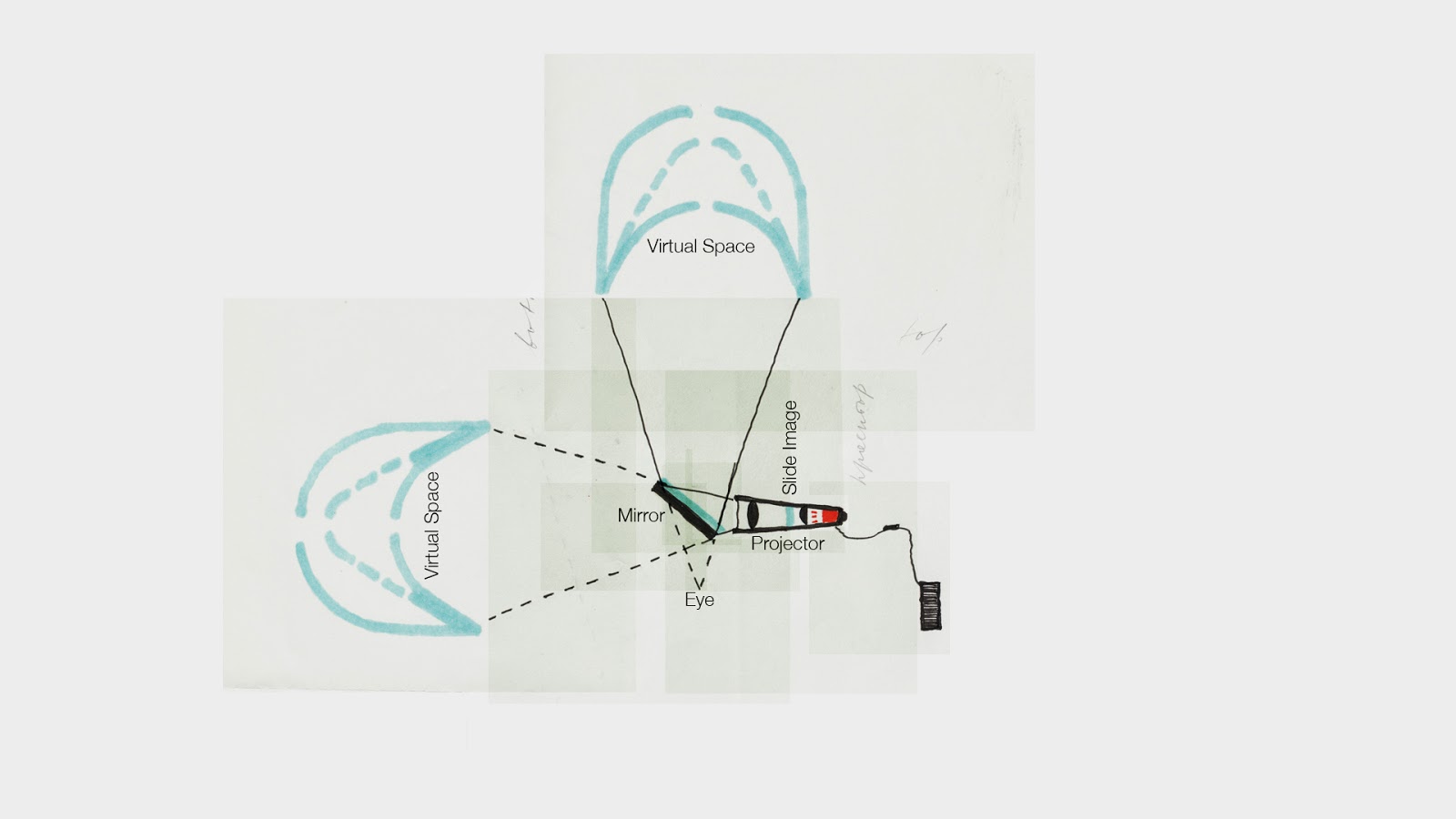
Scheme 3

This experiment allowed me to test forming new relations between the eye of the viewer and space, substituting real space with a virtual (imaginative) one. 

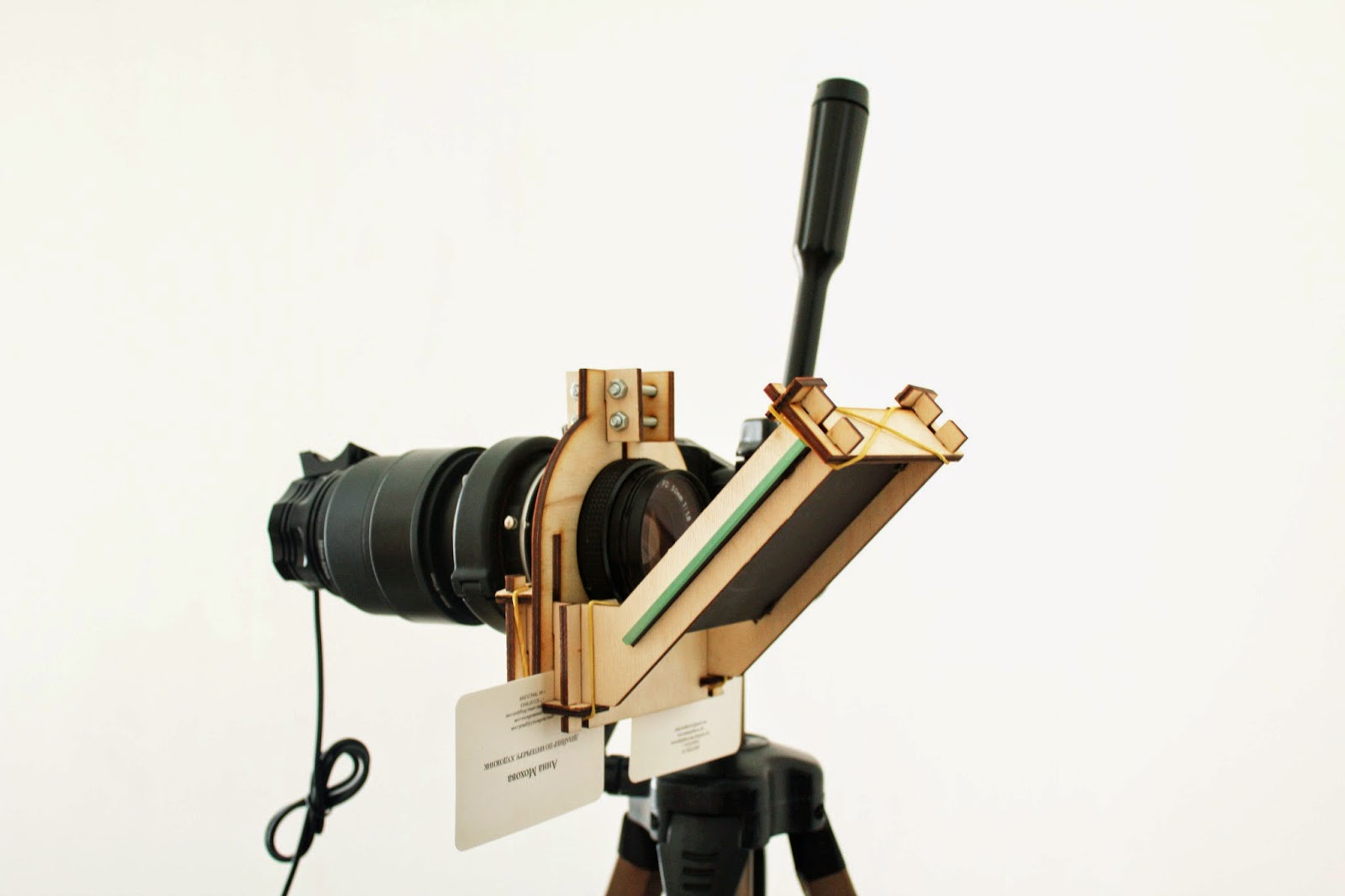
Device photograph

Me presenting work done during the workshop at Strelka

Device applied to projector used during presentation

Image projected during the event

I consider workshop itself, device elaboration and presentation as a valuable experience. I have made some tests with slides and I see more opportunities for application of this new knowledge. I believe it would be really interesting to explore layering and projection. By this I could work more with projected spatial images rather than printed, screened or reflected in a mirror. 

Wednesday, 21 May 2014

Device for Projection Forwarding. Making and Testing.

While considering images I intend to project during presentation, which is to happen tomorrow at Strelka, I also decided to think of how I am to project them. For this I have found inspiration in the process of creating a slide. As my images are digital, they will have to be converted into analogue ones in order to develop slides, so the position, in which both photographs are to be taken, will differ.

Digital image

I have taken a digital photograph of space holding my camera vertically, while a screening of this digital photograph was taken while holding analogue camera with positive film horizontally. In my performance I have decided to preserve this sequence of how view of space turned into image and then into projection. For this purpose I have elaborated a device, which is to forward projection rays into a different direction.

Projector with a device #1 attached

Projection made using the device #1
The first prototype didn't forward the image in the right direction as the glass was not positioned at 45 degree angle due to some constructional issues: the device was rather 'hanging' on the lens rather than clutching into its surface due to lack of fraction between wood and plastic and weight of the mirror, making one side of construction heavier than other. This analysis resulted in creating another device, in which I made attempts to solve some of these issues by adjusting some details, adding new and adding rubber bands to stabilise joints.

Device #2

Device #2

Device #2 video
It seems I have solved most of issues, but there is still some work to be done: for now I have paper cards to apply tension and fix the joint between to elements. A video shows the projection with a stroboscope light on.

Monday, 19 May 2014

Clement Briend's workshop experience: projection

I have visited Clement Briend's 'Projection Art. From Theory to Practice' workshop recently at Strelka, which seems to be a very useful experience. I have been looking into opportunities to use projection on 'Screens' instead of photographs, videos or mirror reflection of space for a while, and it looks like this tool could become a solution. For now I am exploring different types of optics I have.

Canon Lens FD 50 mm

Canon Lens FD 135 mm

Tokina Lens 28-70 mm with Tokina Doubler for C/FD set on 28

Tokina Lens 28-70 mm with Tokina Doubler for C/FD set on 70

Tokina Lens 70-210 mm with Tokina Doubler for C/FD set on 70

Tokina Lens 70-210 mm with Tokina Doubler for C/FD set on 210

It seems from experiments that Tokina 70-210 mm lens is the best option for small scale projection, while Tokina 28-70 mm and Canon 50 mm lenses are the best for huge projections. However, Canon 50 mm lens seems to be more bright hence there is no added zoom optics. Canon 135 mm lens seems to produce a projection almost as small on produced as Tokina 70-210 mm lens set on 210, but seems much brighter as well. Overall, it does look like it is preferable to pick a lens without any zoom optics. I hope I will explore this tool further with mirrors and try to apply particular lenses to project images in my devices.